

Place Vendome
Place Vendôme: Paris Iconic Square of History, Power & Luxury
Place Vendôme, located in the 1st arrondissement of Paris, is one of the city’s most elegant and symbolically rich public squares. Celebrated for its architectural harmony and its association with French power, fashion, and refinement, the square represents over three centuries of Parisian history, evolving from royal propaganda space to revolutionary ground, and finally to an international symbol of luxury. Elegant, restrained, and rich in meaning, Place Vendôme remains one of Paris’s most refined and historically resonant public spaces.
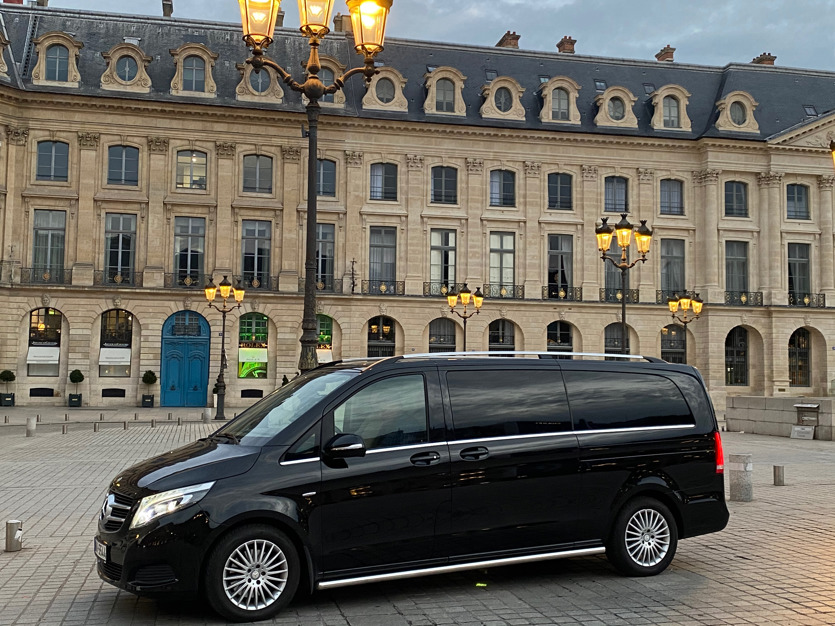
We have made a photo of one of our Mercedes minivans on Place Vendôme
Source: Photo Library Clewel Travel
Historical Names and Political Transformations
The history of Place Vendôme is closely tied to the political changes of France, reflected in its successive names:
- Place des Conquêtes (1699–1702)
The square’s earliest name honored the military victories of King Louis XIV, emphasizing royal authority and national pride at the end of the 17th century. - Place Louis-le-Grand (1702–1792)
Renamed in honor of Louis XIV, the “Sun King,” this period marked the square’s full integration into Parisian life. A monumental equestrian statue of the king dominated the center, reinforcing the image of absolute monarchy. During the 18th century, it hosts the annual Foire Saint-Ovide, a prestigious seasonal market combining commerce and entertainment. - Place des Piques (1792–1795)
During the French Revolution, royal symbols were destroyed, including Louis XIV’s statue. The square’s new revolutionary name referenced the pikes (piques) carried by the people, symbolizing popular power and the fall of the monarchy. - Place Vendôme (from 1795 to the present)
The square received its current name after the Duke of Vendôme, and unlike many other Parisian places, it retained this name through the Empire, monarchic restorations, and republican governments. - 1810. The Vendôme Column is erected by Napoleon I to commemorate the Battle of Austerlitz. In 1871 The column is dismantled during the Paris Commune and later reconstructed.
Late 19th–20th centuries and Today Place Vendôme becomes increasingly associated with luxury, fashion, and high jewelry. It became one of Paris’s most prestigious historic squares, uniting architecture, history, and luxury commerce.
Place Louis-le-Grand as a Market and Social Space
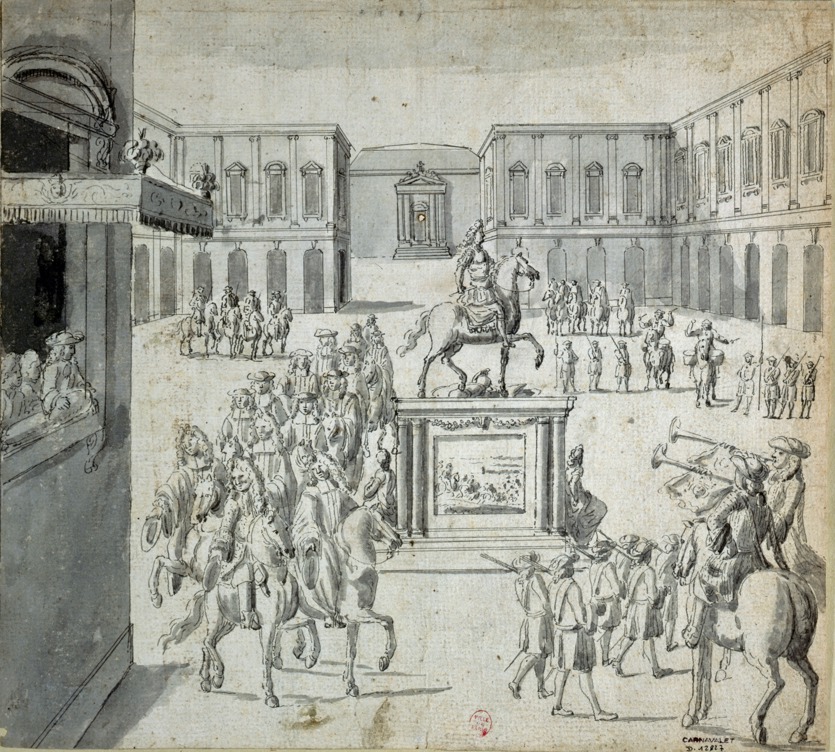
Place Vendôme under the Sun King Louis XIY called Place Louis-le-Grand (1702–1792).
Source: Musee Carnavalet, Paris
While Place Louis-le-Grand is often remembered as a ceremonial royal square, it also played a surprisingly lively commercial and social role in the 18th century.
During this period, the square periodically hosted a major Parisian fair known as the Foire Saint-Ovide. This fair was not permanent, but took place once a year, generally in late summer or early autumn, and lasted several weeks. It transformed the otherwise formal square into a bustling center of trade and entertainment. The Foire Saint-Ovide, held annually on Place Louis-le-Grand during the 18th century, is documented in contemporary municipal records and engravings as one of Paris’s most fashionable seasonal fairs before its relocation later in the century.
The fair offered a wide range of goods, including: Textiles, lace, gloves, and fashion accessories, Jewelry, small luxury items, and decorative objects, Porcelain, glassware, and household goods, Printed images, engravings, books, and sheet music, Toys, curiosities, and novelty items, Food, sweets, and refreshments, sold from temporary stalls and cafés.
In addition to commerce, the fair featured street performers, musicians, and theatrical attractions, making it a popular destination for all social classes. Due to the prestigious setting of Place Louis-le-Grand, the goods sold there were often of higher quality than those found at neighborhood markets.
By the late 18th century, urban reorganization and changing tastes led to the relocation of the fair elsewhere in Paris. The square gradually returned to a more formal and monumental role, paving the way for its later identity as a center of administration and elite residence.
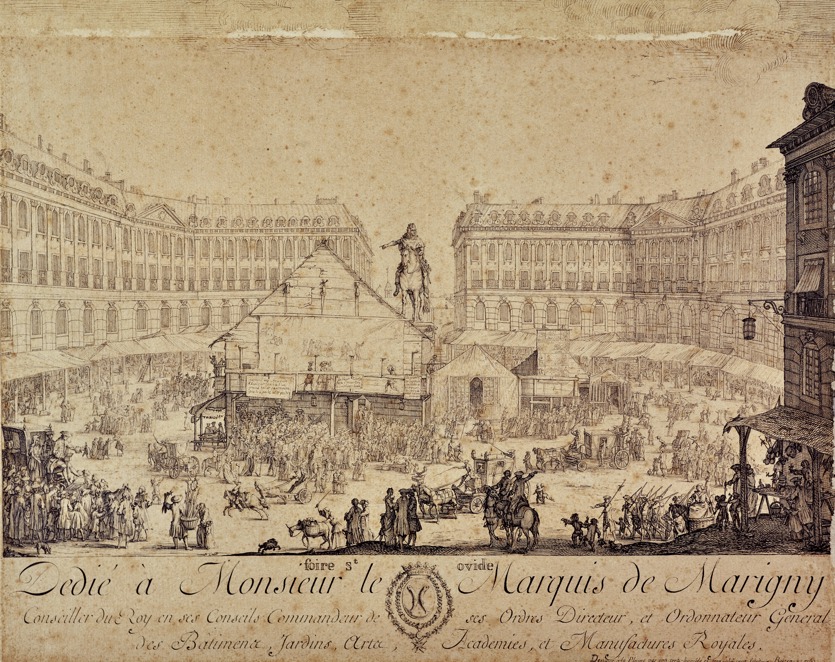
The annual Market called Foire Saint-Ovide on Place Louis-le-Grand during the 18th century.
Source: Musee Carnavalet, Paris
Architecture and Notable Buildings
The architectural unity of Place Vendôme is one of its defining features. Designed primarily by Jules Hardouin-Mansart, the square follows an octagonal plan with perfectly aligned classical façades, completed in the early 18th century.
The square is surrounded by 28 historic hôtels particuliers, originally intended for aristocratic and institutional use. Over time, many of these buildings have been adapted for commercial and luxury purposes while preserving their architectural integrity.
Notable landmarks include:
- Hôtel Ritz Paris, occupying the southeastern corner of the square, one of the world’s most prestigious hotels and a longtime residence of artists, writers, and royalty.
- No. 12 Place Vendôme, where composer Frédéric Chopin spent his final days; today it houses the jeweler Chaumet.
- No. 28 Place Vendôme, home to Charvet, the oldest shirtmaker in the world still operating from its original location.
- Several buildings also host institutions of the French state, including parts of the Ministry of Justice.
Luxury Shopping and the Modern Identity
In the 20th and 21st centuries, Place Vendôme became synonymous with high luxury, particularly in fine jewelry and watchmaking. Flagship boutiques of world-renowned houses such as Cartier, Van Cleef & Arpels, Boucheron, Chanel Joaillerie, Dior Joaillerie, Rolex, Piaget, and others line the square.
Together with nearby Rue de la Paix, Place Vendôme forms one of the most exclusive luxury districts in the world.
The Vendôme Column
At the center of the square stands the Vendôme Column (Colonne Vendôme), rising approximately 44 meters high. Its history mirrors France’s turbulent political past.
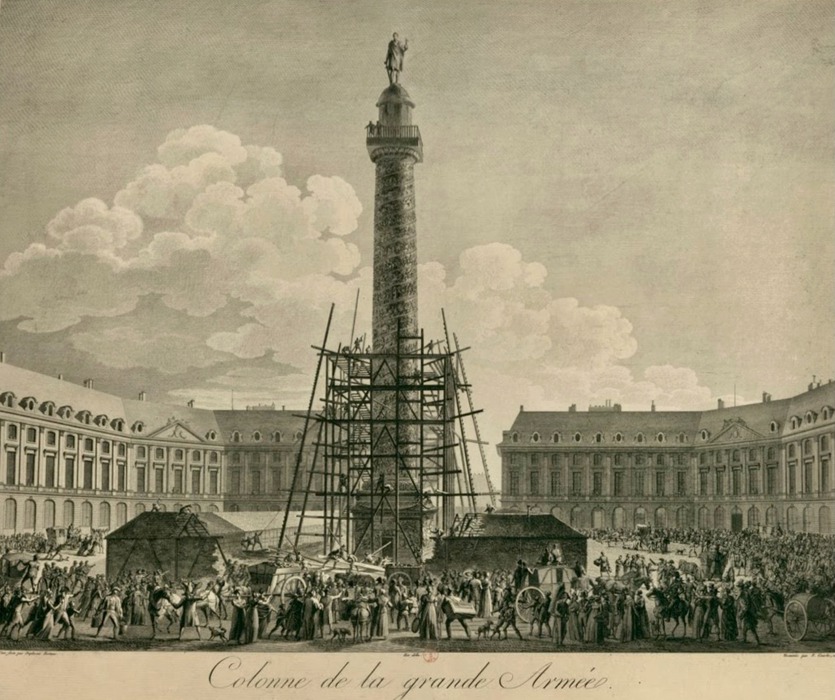
Vendôme Column under construction. Source: Musee Carnavalet, Paris
Originally, the square held an equestrian statue of Louis XIV, destroyed during the Revolution. In 1810, Napoleon I commissioned the current column to commemorate his victory at the Battle of Austerlitz (1805). Inspired by Trajan’s Column in Rome, it was cast from bronze melted down from captured Austrian and Russian cannons and decorated with a spiraling bas-relief depicting Napoleonic campaigns.
The inauguration of the Vendôme Column occurred on 15 August 1810, Napoleon’s birthday, marking the official completion and public unveiling of the monument, although Napoleon did not attend the ceremony.
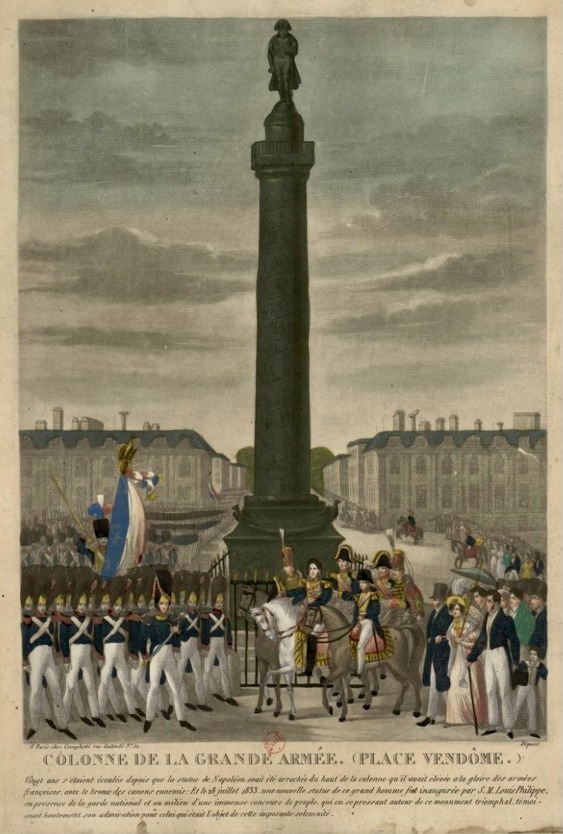
Vendôme Column with Napoleon’s statue from a period print. It may not show the exact moment of the 1810 inauguration, but it is a period depiction of the column crowned with Napoleon’s statue completed shortly after its inauguration and comes from a book of prints published around 1810.
Source: Musee Carnavalet, Paris
The statue atop the column has changed multiple times due to political shifts.
The monument was even dismantled during the Paris Commune of 1871, before being reconstructed shortly afterward. Today, it stands as one of Paris’s most recognizable imperial monuments.
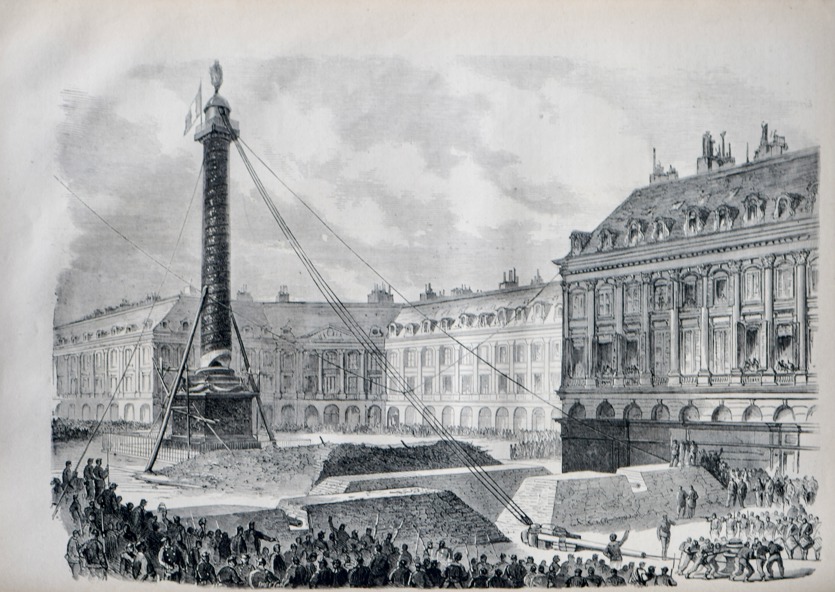
The revolutionaries at Vendôme Column destroying.
Source: Musee Carnavalet, Paris
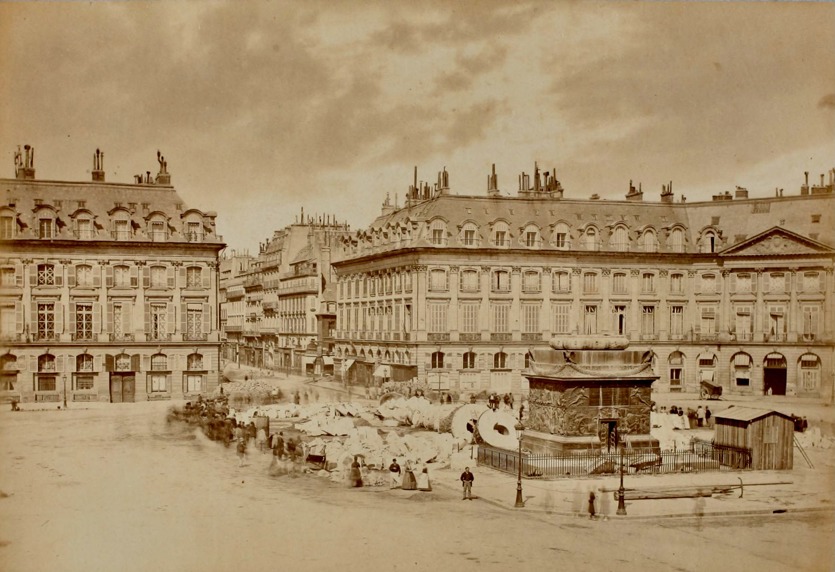
Vendôme Column is now down. Not Nice
Source: Musee Carnavalet, Paris
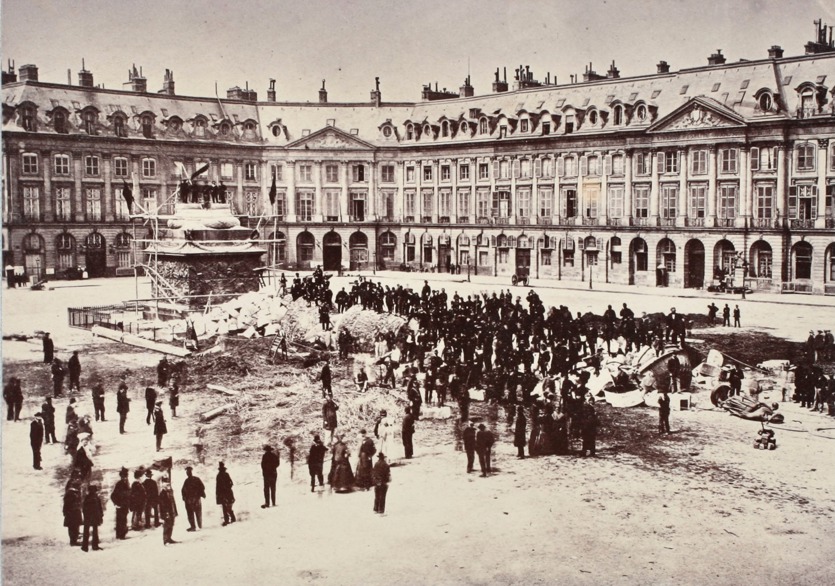
| Source: Musee Carnavalet, Paris |
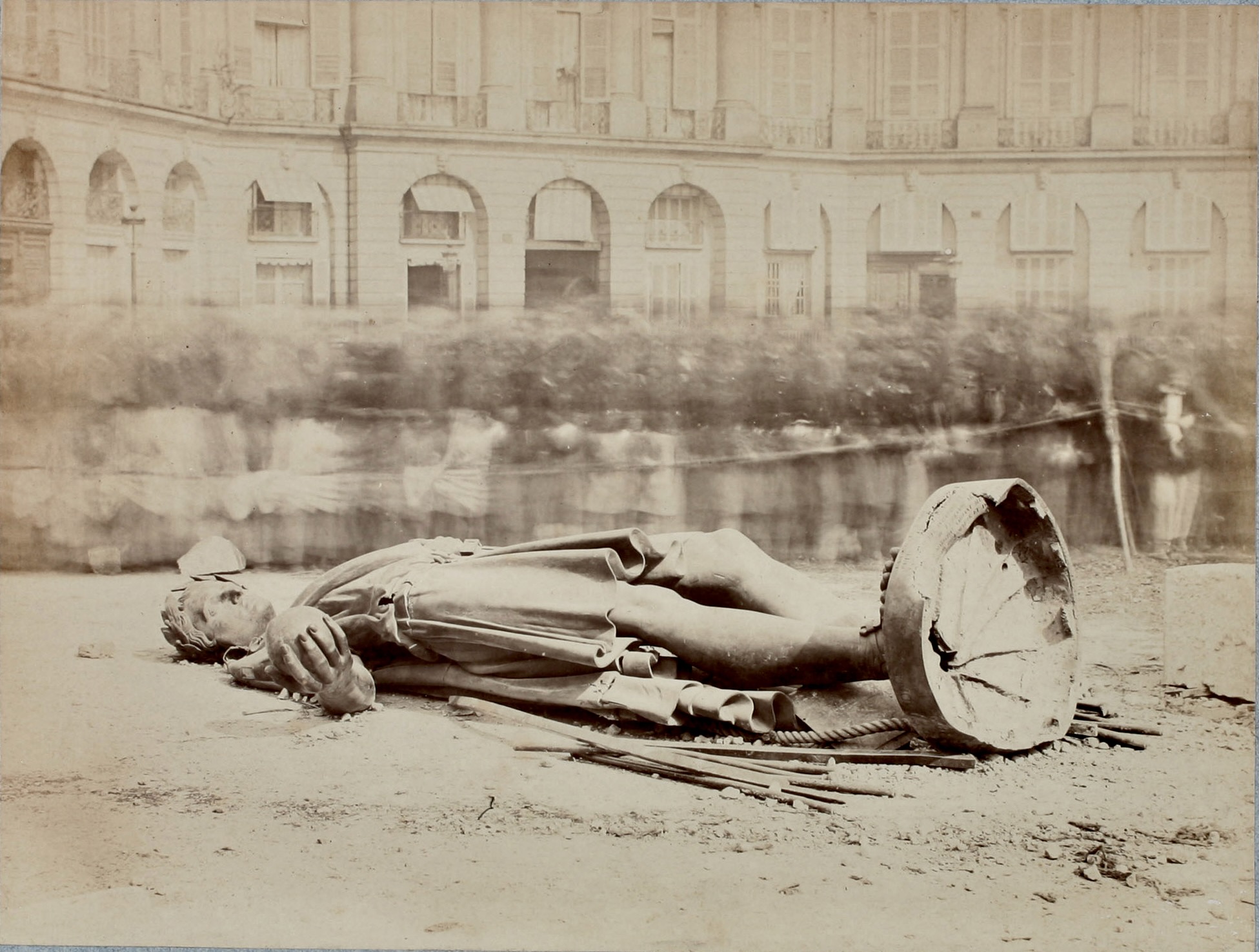
The Statue of Napoleon Bonaparte 1871. Source: Musee Carnavalet, Paris
Provenance of the Name Place Vendôme
The name Place Vendôme derives from the Hôtel de Vendôme, a large aristocratic residence (hôtel particulier) that previously occupied the site and belonged to César de Bourbon (1594–1665),
Duke of Vendôme, the legitimized son of King Henry IV of France and Gabrielle d’Estrées.
The Vendôme family, a cadet branch of the Bourbon dynasty, owned extensive land in this area of Paris. When the land was redeveloped at the end of the 17th century, the historical name “Vendôme” remained attached to the site.
Importantly, the square is not named directly after the town of Vendôme, but after the ducal title associated with the former owner of the land.
The name Place Vendôme was officially adopted in 1795, after the French Revolution, because it was considered politically neutral and rooted in local history.
Who Decided to Create Place Vendôme?
The creation of the square was a royal initiative under King Louis XIV, part of a broader effort to monumentalize Paris and express royal power through urban planning. Jules Hardouin-Mansart was Chief Architect to the King, who designed the square. The decision to develop the site was made between 1698 and 1699. The original purpose was to create a monumental royal square (place royale) centered on an equestrian statue of Louis XIV and dedicated to the his military victories.
The project was financed through a royal-backed real estate development, with standardized façades sold to private investors — an innovative model for its time.
We make a short stop at Place Vendôme during our Paris sightseeing city tour to make some beautiful photos.


Private Tiered Pricing Mercedes
Photos
![System.Func`1[System.String] - Photo](/media/r1enq44i/paris_vendome_i_mercedes_img_0826.jpeg "System.Func`1[System.String] - Photo")
![System.Func`1[System.String] - Photo](/media/4nzk1dcc/place-vendome-name-louis-le-grand.jpeg "System.Func`1[System.String] - Photo")
![System.Func`1[System.String] - Photo](/media/ibtbvwo1/place-vendome-la-foire-market-musee-carnavale.jpeg "System.Func`1[System.String] - Photo")
![System.Func`1[System.String] - Photo](/media/ppnpnktk/place-vendome-culumn-construction.jpeg "System.Func`1[System.String] - Photo")
![System.Func`1[System.String] - Photo](/media/zisbjiij/place-vendome-culumn-inauguration.jpeg "System.Func`1[System.String] - Photo")
![System.Func`1[System.String] - Photo](/media/phoc3d0i/place-vendome-1871-column-demolition-musee-carnavale.jpeg "System.Func`1[System.String] - Photo")
![System.Func`1[System.String] - Photo](/media/50ujcwno/place-vendome-1871-musee-carnavale.jpeg "System.Func`1[System.String] - Photo")
![System.Func`1[System.String] - Photo](/media/4h4lgtck/paris_vendome_iimg_0816.jpeg "System.Func`1[System.String] - Photo")